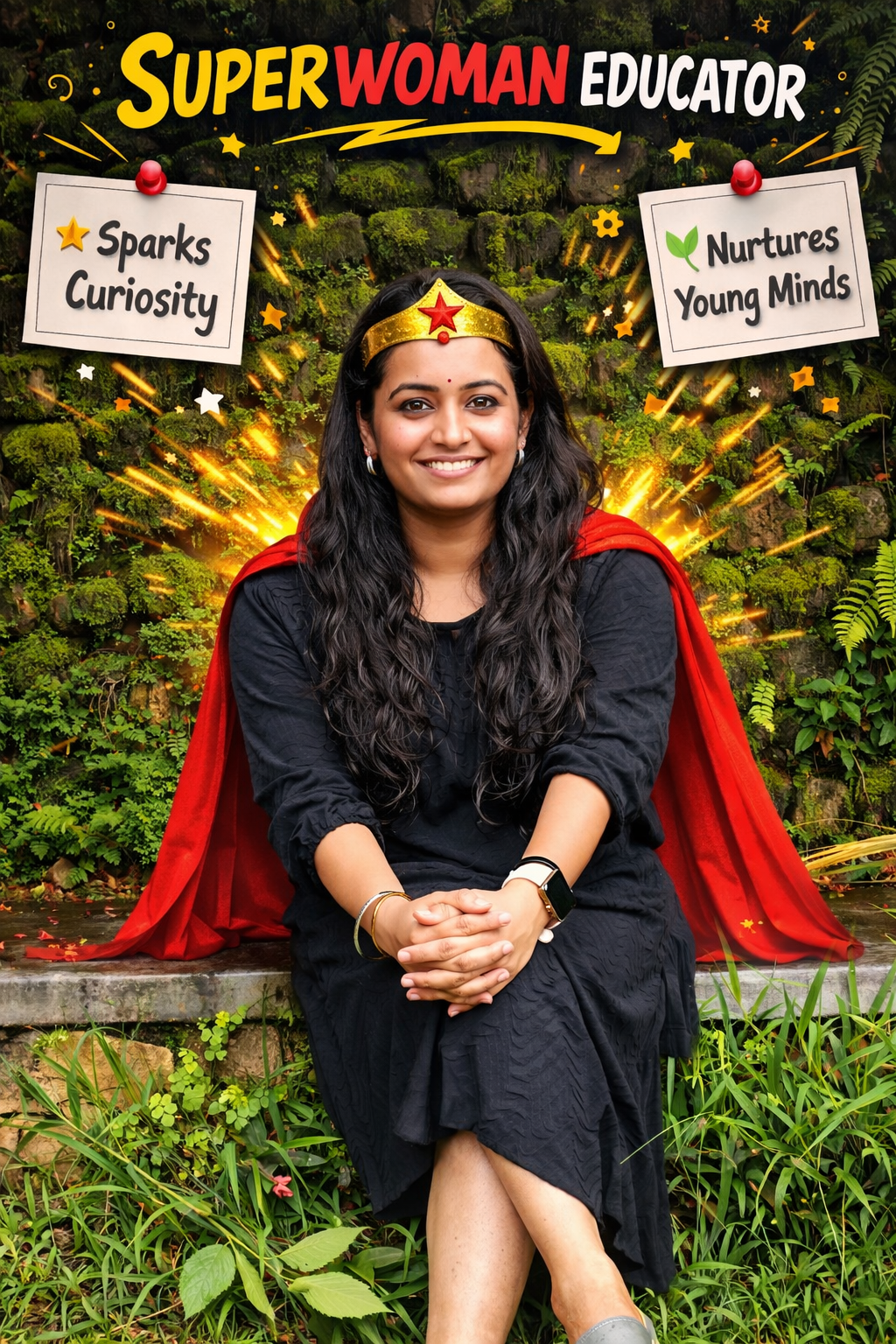
Super hero name : The Curiosity Catalyst
Secret Identity: Kshama V Bhanuprakash
Mission : To spark curiosity, inspire young minds, and make science come alive in every classroom.
Her Superpowers: Lab geek, author, storytelling, Birding, Singing
Signature Strengths : Empathy, Humor, Integrity Transperancy
Her learners often describe her as: Sweet , motherly , agony aunt
An educator, author, editor, storyteller, and many other things that she carries, Kshama is an individual with a tapestry of experiences. A person with such a diverse range of experiences and perspectives brings valuable insights into the classroom that stimulates meaningful learning. Kshama has been in the field of education for more than fifteen years, teaching chemistry and biology across the IGCSE, ICSE, and IB curricula.
She firmly upholds the belief that unlearning and relearning with empathy is her core teaching superpower. As a science communicator, writer, and editor, she is committed to making science accessible in Kannada as well. Words hardly do justice to the remarkable contributions she has made as a science teacher. She has worked as a writer as well as a presenter for science programs in All India Radio, authored a children’s science story series in Kannada, co-founded Dhare Cutlery Bank, which is an eco-friendly initiative, and is a dedicated member of a wildlife conservation group in
Bengaluru.
Kshama recalls being an introvert during her school days. Today, she confidently takes the stage, actively participating in events and seminars and fearlessly voicing her opinions in spaces where they truly matter. She truly believes that a strong community is very important to share and collaborate with fellow educators and understand our learners’ needs. When asked about the one thing teachers should always keep in mind,
she mentioned that it is important for all teachers to prepare for class in advance, respecting the learners’ time, and connecting with the students better.
Looking back at some of her most rewarding moments in her classroom, she fondly highlights her experience with Project Red Gold that deals with genetic variations and blood transfusion as a concept. Students found this project so interesting that they initiated a follow-up activity to conduct surveys in school to find out about the fears and stigmas related to blood donation and prepare presentations based on their findings.
She gladly recalls another such wonderful moment in her classroom where learners were allocated characters based on metals vs nonmetals as the major topic. Metal students arrived dressed in shiny garments, in contrast to the dreary clothes of non- metal characters, to debate whether metals or non-metals are superior.
In her classroom, many seemingly dull topics come alive through creative activities—concepts are often presented through music or poetry rather than through plain PowerPoint slides. Bake cakes and decorate them with candies to showcase human cells. Introducing the categorization chapter through a garden nature stroll, students are asked to contribute images at the end. Imagination has no limit in this science classroom, which is why learners are so engaged in her science lessons.
These tailor-made activities for different learners make the most mundane topics come alive, but there are also some challenges that come along with it. Less attendance at a planned activity necessitates some unexpected last-minute alterations, an extremely intriguing session turning into a yelling competition, and some enthusiastic students overshadowing the quiet ones. These are some of the problems that Kshama has faced in her classroom, but they have not stopped her from introducing new activities. She states that she encourages her students to complete a feedback form on the things they enjoyed and what they would like to see more of in the classroom. This allows her to reflect on what worked in the classroom and what else may be done to help students fall in love with science.
Empathy and humor are the two main qualities that she believes make the learners feel connected to their teachers and more comfortable in the learning space. She believes that one of the most important things educators can do is remind students that they are always there to support them. We hope Kshama continues to share the joy of science through her engaging classes and books, helping students discover a genuine love for
the subject.

 TEACHERS OFF THE SCRIPT