
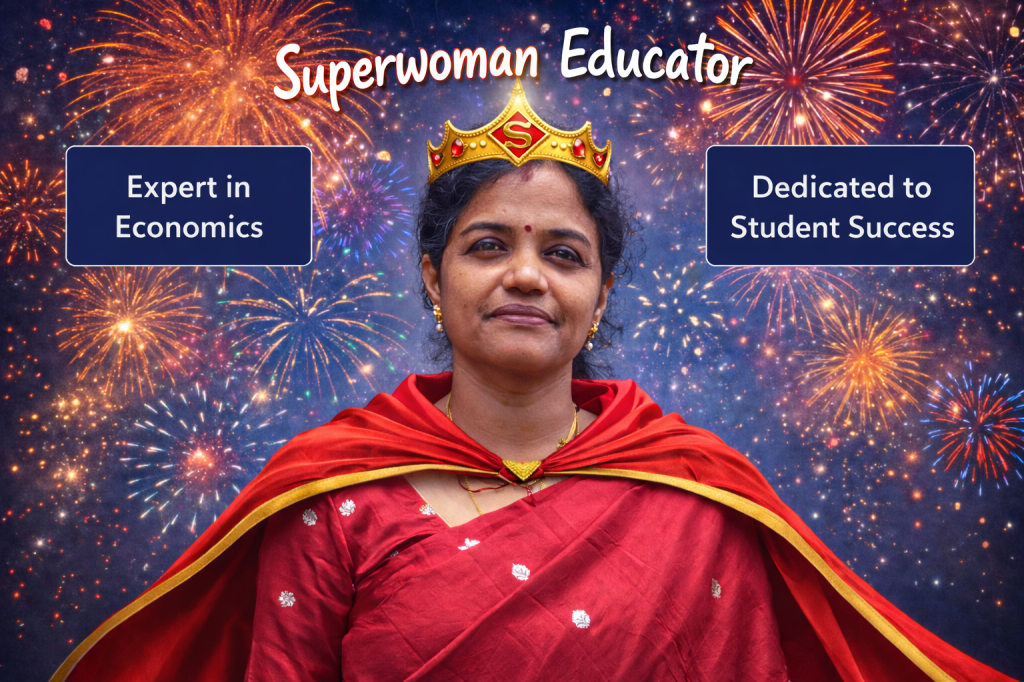
Superhero name: Captain Equilibrium
Secret Identity: Akila
Mission: To empower every mind with principles that turn knowledge into action.
Her Superpowers: Serious in purpose, disciplined in action, and deeply human in care.
Signature Strengths: Constructive toughness, Empathic Insight, Patient Persistence, Practical wisdom.
Her learners often describe her as: Remarkable, Relatable and empowering
Dedicating 13 years of her life to empowering young minds and nudging them in the right direction, Ms. Akila is one of the experienced educators who teaches economic principles and real-time business case studies that help students with financial management to choosing a career in it. She is deeply focused and disciplined in approach when it comes to teaching. She believes it is equally important for the students to be purpose-driven in their learning. She emphasizes how every student studies at their own pace, and it is important for educators to avoid forcing learners into rigid frameworks.
A rigid and authority-driven school system was the normal norm during Ms. Akila’s school days. Discipline and academics were always the focus, and she remembers herself as a student ensuring she puts every effort into that direction. She recognizes that our classroom atmosphere and learning process have evolved in response to changing times. However, she confesses that being a teacher has taught her more about the subject and the learning environment than being a student. She discusses how teaching is a constant process, with everyday learning and lessons that help her develop. She also discusses how, during her three-year teaching break, she continued to be a teacher for her son, assisting him with his studies while simultaneously completing her MBA. This clearly demonstrates how learning continues throughout life and helps one progress at every level, regardless of age or prior accomplishments.
Ms. Akila is a staunch believer that educators continue to function as role models for their learners and that what they teach has an impact on the learners. While digital tools and creative lesson plans are becoming increasingly important in academics, she prefers to use the traditional teaching technique of student-teacher classroom interaction. She explains that it is critical for teachers to communicate with their learners and that these simple exchanges prompt many intriguing enquiries from the students later. According to her, such easy teaching methods allow her to better connect with her learners, making them more comfortable interacting in the classroom.
This is one of the reasons she has only used hands-on activities very few times in her classroom. She feels that basic interaction with learners helps them understand complicated concepts and receive personalized attention in the classroom.
Ms. Akila strongly believes that there is no one-size-fits-all teaching style in the classroom. There are always different learners with varying learning abilities, which she must consider before designing her lesson plans. For her, each batch and academic year has brought a new set of learning opportunities and difficulties. For a batch with many top performers, she decides to challenge them with interesting case studies, whereas for a batch with many average performers, she prefers to start with basic examples and advance to more difficult ones.
Recalling one such episode that stuck with her, she discusses one of her grade 11 pupils who was a slow learner. The student was furious with her for a while since he couldn’t accept that he had a different teacher for the same subject. He kept returning to the old teacher, expressing his discomfort with the unexpected shift. Ms. Akila attempted to address the situation, but nothing seemed to change for a while. She continued thinking about where she had gone wrong and what the learner desired. In subsequent classes, she opted to abandon strict classroom rules in favor of presenting the idea step by step, using simple examples, and fostering discussion. Within a few days, the learner began approaching her with questions and opening up during class exchanges. This encounter reminded her that classrooms are dynamic environments, even with distinct learning styles. Following this experience, she decided to relax the restrictions and allow the learner to take a more active role in steering the class through questions and debates.
Ms. Akila has collaborated with a few departments to ensure that her learners’ academic knowledge is translated into practical implementation. She has worked with the Business Studies and Economics department to teach them about the practical use of the indifference curve. She has also worked with the sociology and media studies departments to discover areas of commonality and address common topics together. She was previously the deputy head for academic quality and will now serve as the Coordinator for commerce and humanities.
When asked about her favorite movie character, she cheerfully names Master Shifu from Kung Fu Panda. She explains how that character is a great teacher in the movie who allows his students to learn and flourish in their own way. She wishes to do the same for her learners as well, and we wish her all the luck as she continues to grow and inspire young minds.

 TEACHERS OFF THE SCRIPT