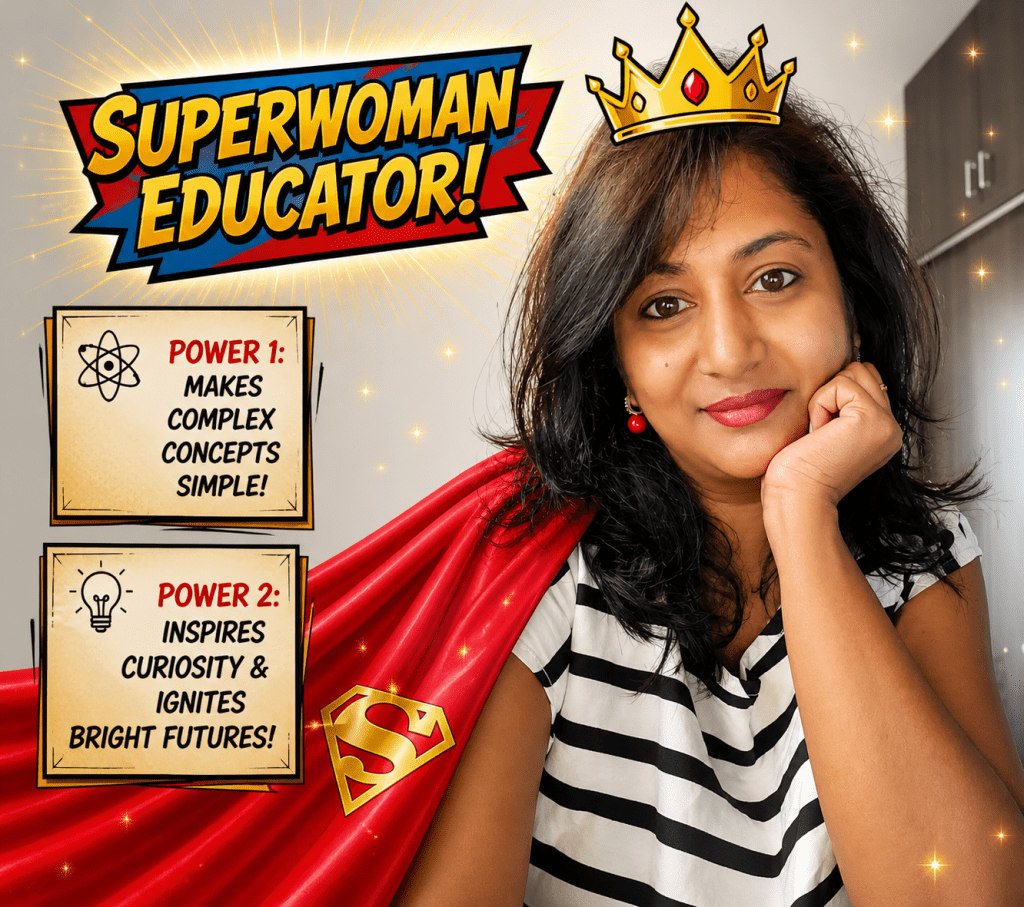
Superhero name: Quantum Catalyst
Secret Identity: Shyamala
Mission: To bend the laws of confusion into clarity and guide young minds through the vast universe of ideas.
Her Superpowers: Energy amplifier, curiosity ignition through experiments, engaging lessons
Signature Strengths: Experiential teaching, innovative experiments, inspired artist, freehand sketching, graceful dancing and culinary skills
Her learners often describe her as: innovative, inspiring and thoughtful.
Ms. Shyamala is a versatile educator who holds 15 years of experience under her belt. Since 2016, she has served as the team leader for the Physics ICSE examination evaluation. During her time at BASE (Be Ahead with Sustained Excellence) in Bangalore, she had the opportunity to attend a workshop in Pune led by Prof Arvind Gupta, who has received the Padma Shri for his science toy-making program. She was greatly excited by the trash-to-toy programme and decided to implement it in her classroom in her own unique way, using trash or leftover things to do simple experiments.
She has also led learning and development programmes for rural children at the Viveka Tribal Centre, teaching them communication skills and other vital soft skills. She extended similar training to Gandhipur government college students to help them improve their interpersonal and professional skills.
A physics enthusiast who aims to make each learner experience the beauty of physics in the world around them. Ms Shyamala believes that physics can be untangled when even the most complex topic is explained with simple examples. She believes it is important to encourage students to learn physics from everyday life examples that can give them a clear understanding of the topic and, most importantly, make them experience the concepts rather than limiting it to pen and paper.
As a student, she reflects on her time in a conventional school environment where students often hesitated to approach teachers, and strict academic discipline shaped the core of the school’s value system. However, she recalls that her teachers would always focus on experiments before introducing a new topic to pique learners’ interest, something she does now as an educator. While she learnt many concepts in the classroom, she believes her deepest understanding came from the world around her—especially from her father, who loved sharing stories.
With excitement in her voice, she recalls how he would narrate countless stories and then ask thoughtful questions to check her understanding. Looking back on these childhood memories, she realises that those simple, meaningful interactions with her family and surroundings taught her invaluable lessons—ones she now carries into her own classroom as she nurtures her students.
Ms. Shyamala is a major believer in the importance of providing learners with strong conceptual clarity through linkages to real-life circumstances. She gives an example from her classroom, where she noticed bewildered faces staring at her as she began teaching the centre of gravity. She instantly paused and improvised the lesson by grabbing a ruler and an eraser to teach them the same principle. She noted an immediate shift from perplexed to curious faces, indicating that students not only comprehended the concept but were also curious about the whys and hows.
She feels that patience and active listening are essential in the classroom, as they create a secure space for learners to ask questions and express themselves. Every day, she makes a conscious effort to create this safe environment. One approach to ensure this is to pay attention to the class’s mood. Simple things to lighten the atmosphere include meditating, playing a fast game, or teaching them valuable life lessons through a short narrative. Ms. Shyamala believes that this is an excellent technique to ensure that learners are on the same page before beginning a new idea in class and are prepared to participate in the classroom. She often enjoys discussing her own college experiences and tiny anecdotes with her learners, which helps them feel more connected and open up to her.
She enjoys experimenting with digital technologies to educate learners about different concepts. She recommends programmes such as O Labs, PhET simulations, and SimBucket, which she has used with her students to do brief e-lab sessions that improve engagement and knowledge of the concept. When asked about her teaching technique, Ms. Shyamala says she believes in the 4D model: discover, design, develop, and deliver. Her only goal is to make physics an accessible topic for all of her students. She just lays down all of the technical jargon in layman’s terms, making it appear simple to assist students in overcoming their prejudices about complex or difficult subjects.
Ms. Shyamala also states that she is a kinaesthetic learner, which is why she creates sessions that need active, hands-on engagement. While teaching DC motors, she led a practical session with readily available supplies, and the students’ reactions were overwhelmingly positive and engaging. This is the type of situation that drives and inspires her to improve as a facilitator. It’s always a proud moment for her when students stop memorizing formulas and start thinking—when they ask “why” and “how” or connect physics to real-life events.
When asked where she finds motivation to keep teaching young minds, she says that Swami Vivekananda is a real inspiration who thought that learning should involve more than just reading textbooks or chapters—it should also involve experiencing and witnessing the knowledge. Ms. Shyamala continues to teach with total dedication to all her learners while adhering to this ideal, as evidenced by the many accolades and awards she has received, including the IIHM Teachers Day Award. This demonstrates her passion and commitment to making learning meaningful in each of her classes.


 TEACHERS OFF THE SCRIPT