
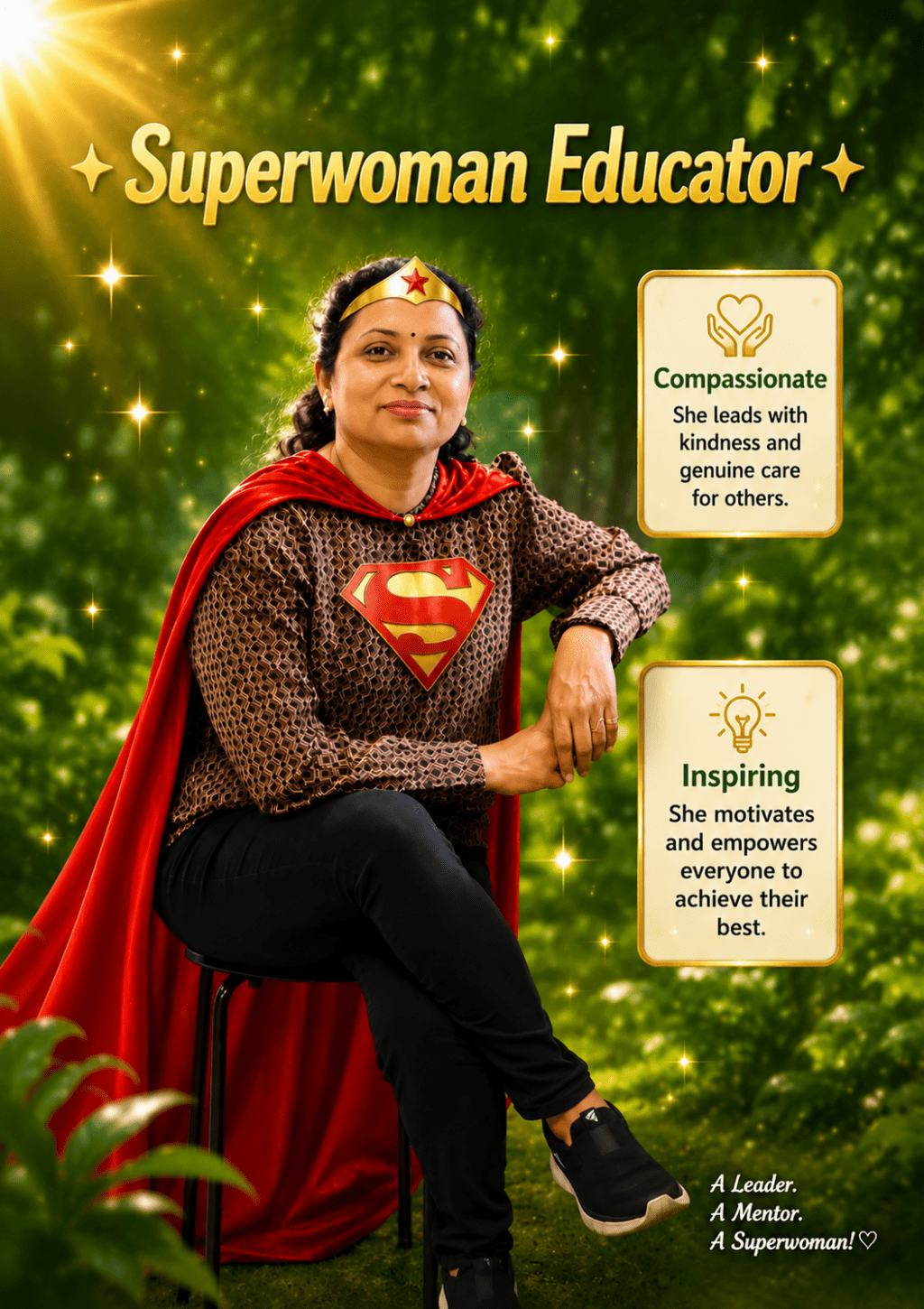
Superhero name: Cellular Supernova
Secret Identity: Shantala K
Mission: Using creativity and curiosity to unlock the wonders of life science.
Her Superpowers: Lab geek, nature enthusiast and storyteller wizard
Signature Strengths: Innovative experiments, nature-inspired learning and interactive science storytelling.
Her learners often describe her as: Enthusiastic, approachable and Inspiring
Ms. Shantala finds teaching to be both interesting and enjoyable, as she loves passing on knowledge and learning new things along the way. She feels that it is critical for every educator to make the learning process engaging, kindling their interest rather than the monotonous routine, where studying becomes burdensome for some students. She has wanted to be a teacher since she was a child, and nothing makes her happier than this profession.
Revisiting her 25-year teaching career, she joyously recalls so many of her students leaving their mark on the world, returning to the school campus and reminiscing about school memories with their favorite instructor. This is the most blessed moment in her teaching career for her because it allows her to see her learners grow and prosper as they apply what they have learned in the classroom.
Ms. Shantala recalls that as a student, discipline was the primary focus of her school. Academics would be the priority at her school, and she would flourish academically year after year. She believes that the discipline instilled through her education enabled her to carry out her tasks and job successfully and with complete dedication. Although her school was relatively far from home, her family members and aunt ensured that she completed her studies and school without fail.
Ms. Shantala is a firm believer that active learning is the only way for students to remember and recall things effectively. She explains that engaging storytelling may help us understand even the most complex issues. Powerful stories have the capacity to ignite learners’ imaginations, allowing them to relate to subjects more quickly. She sometimes becomes creative and assigns each character a name that is identical to the terminology used in the concept. She considers this to be one of the most efficient strategies to familiarise learners with a new topic. Most of her classes will also include summarizing activities to ensure that students understand the concepts.
Classroom learning does not end with these activities. Ms. Shantala enjoys experimenting with new ideas for her learners. She chose to allocate four different colors to four separate teams for the ‘circulation’ topic. Most learners enjoyed working together to create a visual representation of the subject. This appears to be a successful method for teaching students’ critical life skills as well as classroom ideas. According to her, effective group work using target-orientated strategies increases learners’ focus, accountability, and productivity.
She describes another intriguing classroom exercise with story cards, in which she handed four distinct story cards to students, enabling a learner-led classroom environment in which they investigate the subject using learning resources and questions to assess their learning. To make it more intriguing, she included activities relating to the concept and let students examine the story cards at their leisure. However, while some learners received enough knowledge and answered the questions, others took longer to finish the job.
While carrying out this activity for the students, Ms. Shantala realized that the time taken needs to be flexible to accommodate all types of learners. Different learners will approach the task in different ways, at their own pace. She admits that time constraints and classroom dynamics are important variables in the successful implementation of any classroom activity. There are instances when the activity is not entirely successful, but thinking on how it may be improved allows educators to reconsider and reassess their teaching practices.
She also emphasizes how exam preparation might limit classroom activity as students focus on exams. Ms. Shantala states that she creates activities that assist students in learning the topic in an enjoyable manner while still focusing on exam preparation and revision. She reminds us that teaching is a continuous role that does not end with the classroom and tests. Educators come up with various ideas for classrooms, prepare learning materials, and organize the implementation of courses in the classroom, to name a few of the many additional jobs that they perform on a regular basis.
Ms. Shantala passionately believes in fostering a collaborative culture within science departments and has worked on problems that are related. Aside from that, she has partnered with the art department, where one of the themes was biosymmetry, and she chose to exhibit natural structures through an art exhibition. She hopes to continue working with many departments on fascinating projects in the future.
Ms. Shantala describes her teaching technique, in which she spends the first half of the lesson enabling learners to lead the discussion and think about the topic. She goes on to summarize the information from her learners and contribute to the conversation in the second part of the class, with the goal of maintaining a student-led classroom environment. She also mentions how she enjoys questioning her learners to get them to think about the concepts she teaches, and the learners enjoy asking her questions to learn more about the subject. This ongoing cycle of questions makes the lecture more enjoyable and intriguing for both the students and Ms. Shantala. She continues to inspire young minds with her creativity, compassion, and commitment to making learning relevant. Her story reminds us that outstanding teachers do not merely teach lessons—they leave a lasting impression on every student they nurture.


