
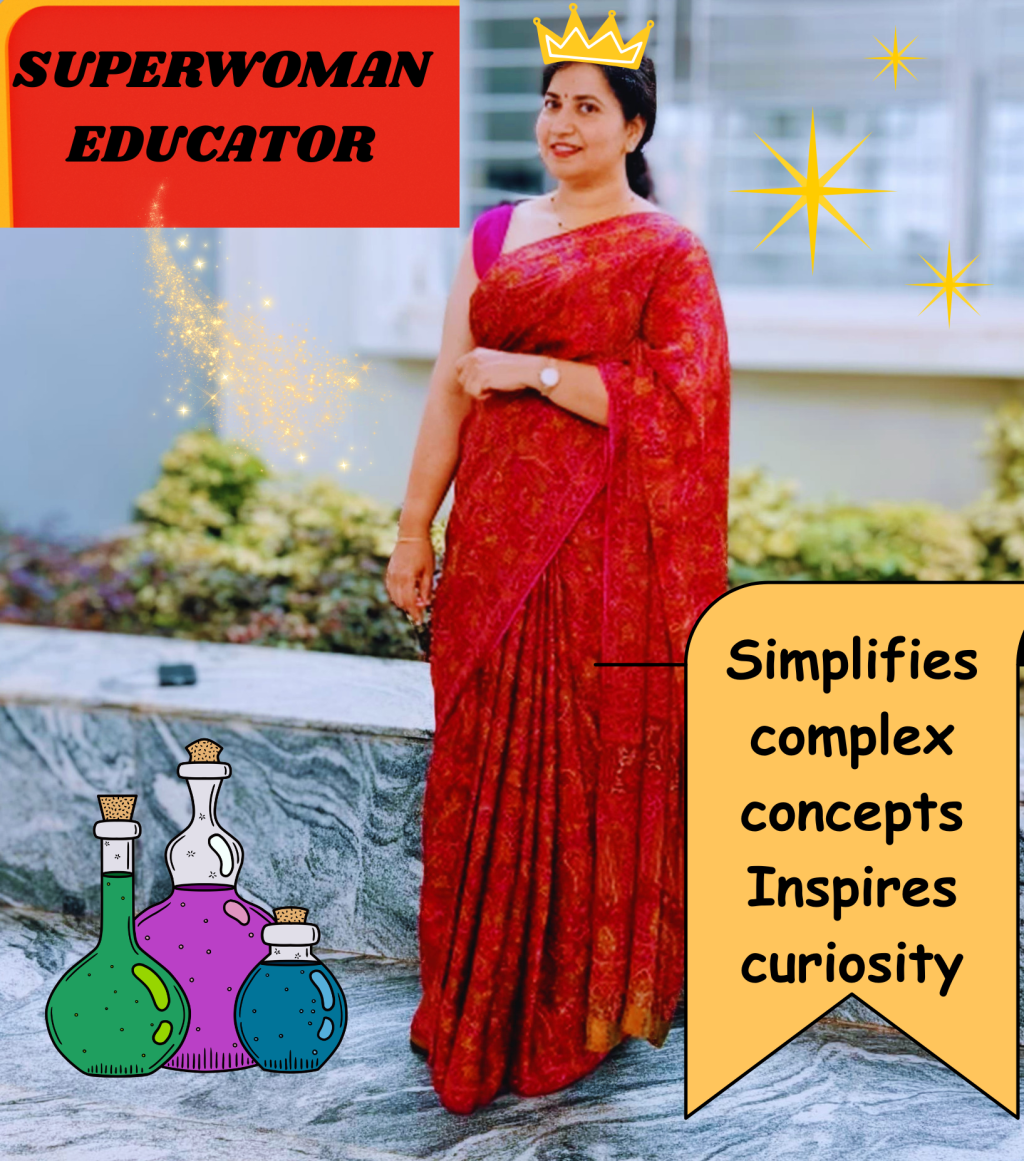
Superhero name: The Element Enchanter
Secret Identity: Manasa
Mission: On a mission to turn chemical reactions into exciting discoveries.
Her Superpowers: Lab geek, concept decoder, artistic spark and student-first vision
Signature Strengths: Creative lesson designs, innovative experiments and interactive science storytelling.
Her learners often describe her as compassionate, patient and inspiring.
Ms. Manasa believes in simplifying chemistry and connecting it to real life examples that help students see the subject with curiosity instead of fear. It is crucial to her that her students not only view chemistry as a subject but also experience it through the things around them. She believes that chemistry can be learned through things in our environment, such as the food we eat, the air we breathe, and even the way we think. This became her primary goal for becoming a teacher; she wanted all of her students to experience the charm of chemistry.
Her teaching journey may appear unusual. She began teaching in colleges and eventually moved on to high school students. That move completely altered her perspective on the subject. She discusses how college students engage differently since they have passed the high-stakes threshold. However, when it comes to school learners, facilitators enter a room full of pressure that isn’t wholly their own. It is based on expectations, comparisons, and years of being told that this stage is the phase that determines everything.
Ms. Manasa discusses her experience preparing for difficult entrance examinations, which taught her what no instruction material could: the exhaustion of feeling as if every chapter you don’t comprehend is a closed door. Clearing the SLET somewhere along the way reminded her that proper preparation is deeply personal and that confidence in a subject stems from understanding it rather than simply knowing it. That’s also true in high school, where everything becomes so hyped up that the subject itself is overshadowed by fear. Learners begin studying fear more than they do actual content. She believes that her job is to take that away. To make the subject feel more approachable. She aims to remind them of their strength in overcoming the pressures they encounter. She adds that teaching younger learners humbled her. It prompted her to create simpler, clearer ways to explain tough concepts, and that is the type of teaching she wants to continue pursuing.
As a student, she recalls how learning in the classroom felt scary, with many questions and curious thinking getting lost in a rigorous classroom environment. Ms. Manasa says that she retains that experience with her to this day, which is why she reminds herself every day to intentionally create an environment in which children feel safe or comfortable expressing questions without fear or condemnation. She firmly believes that even the simplest questions can ignite important classroom discussions, making it essential to cultivate curiosity in the classroom, inspiring.
Experimenting with new ideas and activities for the classroom is a constant for Ms. Manasa as she remembers conducting a lot of intriguing experiments and activities that made things easier for the learners to understand. One of the best ways to explain a concept to students, she says, is to delve into the history of the subject or look into significant historical figures or events in the field of chemistry. The final questions should be open-ended to encourage further thought. Occasionally, this is supplemented by brief activities that help students gain more understanding and clarity. She referred to one of the recent activities she conducted in class where she came up with a few magic experiments to draw the high school learner’s attention to the concept. She mentions that it is the best feeling in the world to see learners shift from hesitation to genuine interest and grow to love the subject.
Ms. Manasa believes that it is critical to foster an environment of interdisciplinary collaboration. Science educators frequently meet to review classroom practices and areas for improvement. These discussions allow each of them to reflect on their own teaching approaches while also learning from their colleagues about other great ideas that may be implemented. She believes that one of the most effective ways to teach topics to learners today is through interactive group activities, group discussions, or even simple activities. These activities can help students connect with any idea and develop real-world skills like cooperation, critical thinking, empathy, and conflict resolution.
She emphasizes that educators actually care about their learners’ development—not only intellectually, but also personally. They enthusiastically applaud learner achievements and guide them in the right way. It’s never just about the subject; it’s about guiding learners toward self-confidence. For her, it is critical that no student dislikes a subject merely because they are frightened to engage with it. She continuously reminds herself to be patient, approachable, and clear when teaching.
She hopes everyone acknowledged that even though educators only spend a few hours every day with learners, the connections they form with them can be profound and long-lasting. It’s never just about the subject; it’s about guiding people toward self-confidence. Ms. Manasa inspires learners to see chemistry beyond textbooks through her enthusiasm for teaching and her positive approach. She tells students that the best science starts with curiosity.


